
After consulting with a professional dog trainer or behavior consultant, you’ll likely receive a written behavior plan.
Your dog’s behavior plan is tailored based on several factors:
- Genetics and breed-specific behaviors
- Age and size
- Health and medical program
- Learning history
- Unique characteristics and personality
- The family
- The family’s home setup
These factors play a role in creating a customized behavior plan for you and your dog.
It’ll be based on your environment, your dog and where they are currently at, and your needs and capabilities as their guardian.
Framework for progress in your plan
Professional trainers use different frameworks and formats when creating these behavior plans.
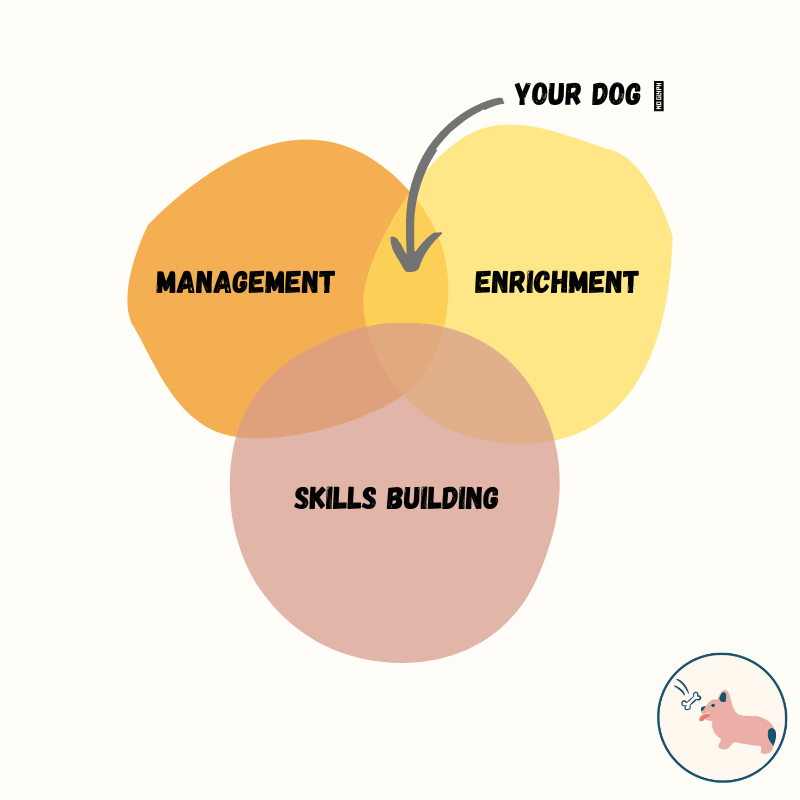
I use a framework that touches on three (3) key pillars of behavior change and skills teaching. If you decide to work with Diwa Dogs on your behavior or training goals, these are the three things you’ll often hear me talk about and actively guide you through:
- Management
- Enrichment
- Skills building (also known as “dog training”)
It’s a completely different approach to the traditional punishment-based training methods commonly used in the Philippines.
Rather than assuming a one-size-fits-all approach, you’ll cover all three bases to make sure you meet your dog’s needs and set them up for success.
Management
Management is how you’ll customize or control the environment you and your dog live in to make sure you prevent the practice of unwanted or undesired behaviors.
Whether that’s chewing on Dad’s tsinelas or digging through Mom’s garden 😱 you can use management tools or make changes to the home, so that your dog won’t go after these things anymore.
Management also helps keep anything your dog finds scary or overwhelming at a distance where they feel safe or secure. This is especially important if you’re working through a plan that involves behavior modification.
Learn more in this Instagram post.
Enrichment
The second pillar in your behavior plan is canine enrichment.
I’m a huge fan of Allie Bender and Emily Strong’s definition of enrichment as part of your dog’s behavior plan:
Enrichment is learning what our dogs’ needs are and then structuring an environment…that allows them, as much as is feasible, to meet those needs.
Canine Enrichment for the Real World (2019)
Yet, the concept of providing your dog an environment that meets their species-specific needs is still new, sometimes foreign, to Filipino homes. 🧠
If you’re unfamiliar with enrichment, you’ll find that this is going to be a huge priority when working with a professional before even going into implementing any type of teaching protocol.
Download the Canine Enrichment handout from my Resources page.
Skills building
Once we’ve achieved a management and enrichment strategy that prepares you and your dog for learning, you’re ready to teach skills they will need to thrive in your home and make good choices. 🧑🏫
Settling on a mat, greeting other people politely, leaving nasty things on the ground, or ignoring other dogs are skills that you can teach to add or replace all the unwanted behaviors you’re struggling with.
A professional dog trainer or behavior consultant will help you learn how to implement these protocols with little to no force as possible. They’ll guide you and provide feedback with your timing, treat delivery, leash handling, and more.
Ready to (re)start dog training?
Whether your dog’s reached their senior years, or you feel there’s a lot of catching up to do, today will always be the best day to (re)start your dog’s +R training journey. And if you’re already working with a trainer, see if they follow or understand these same concepts in their methods.
Happy training!
— Stef, Diwa Dogs. 🐾
 Diwa Dogs
Leave a comment